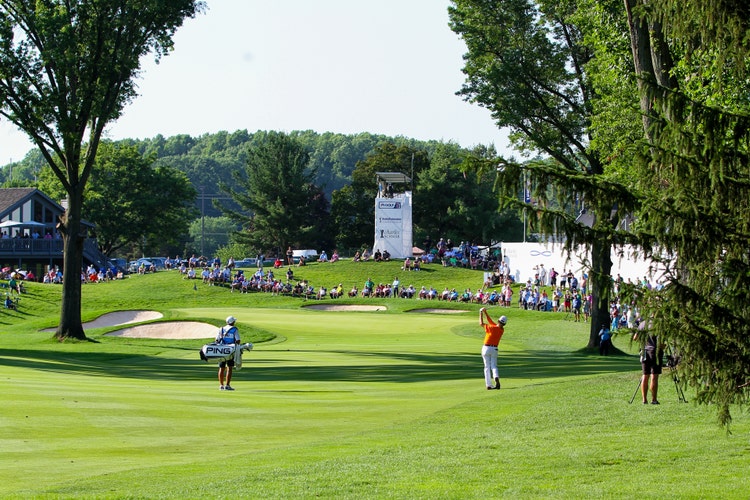
Firestone Country Club South Course
Renowned for its extensive tournament history, the par 70, South Course at Firestone includes some of the toughest, most famous and most enjoyable holes in golf. A championship course from its conception, the South Course has hosted more than 70 professional tournaments.
The South Course was originally designed by Bert Way and debuted as the inaugural course at Firestone Country Club in 1929. In preparation for the 1960 PGA Championship, Robert Trent Jones Sr. undertook an extensive redesign, adding over 50 bunkers, two ponds, and increasing the course length to 7,165 yards while adjusting the par to 70.
HOLE
PAR
YARDS
DESCRIPTION
1
4
389
Accuracy rather than sheer power is necessary to navigate the fairway bunkers. A successful second shot will leave the ball below the pin. The green, which slopes from back-to-front, is guarded by a false front, a deep bunker to the left and a large shallow bunker on the right.
2
5
529
Pros think birdie on this par 5 with overhanging trees at the narrow dogleg left. A long and accurate tee shot will tempt players to reach the green in two shots. A nest of bunkers protects the most undulating green on the course.
3
4
420
The tightest driving hole on the course, many players will hit less than driver to find the tree-lined fairway. The green is guarded by a pond in the front and three greenside bunkers.
4
4
450
This hole is one of the most difficult par 4s on the course. The fairway slopes right-to-left and is guarded by a fairway bunker on the right-hand side. The second shot must come in high to hold the elevated green that features a false front.
5
3
200
The challenging green slopes from right to left and requires accurate club selection as well as precise shot making in order to have a good look at birdie.
6
4
460
The sixth is a slight dogleg right with a semi-blind tee shot that is one of the tougher holes on the course. The green slopes back-to-front and is surrounded by three bunkers.
7
3
205
The seventh hole can play very different each day of competition with a long tee box and multiple pin placements on the largest green on the course that is open in the front. There are bunkers beside and over the putting surface.
8
4
470
A slight dogleg right, Jack Nicklaus once called this hole his favorite on the course. The green is open in the front and runs away from you. Missing a shot in the deep bunkers left or right of the green will leave a difficult up and down.
9
4
460
Playing back up towards the clubhouse, multiple bunkers guard a fairway that slopes left-to-right. A challenging approach into a small green with a false front awaits the players.
10
4
410
A ribbon of fairway is protected by multiple fairway bunkers which makes for a challenging tee shot. This back-to-front, undulating green requires an approach that stays below the hole.
11
4
418
Most players will have a short iron to this wide green, featuring a shelf on the back-left section. One of the few birdie opportunity holes on Firestone South.
12
3
180
This is the shortest hole on the course. The picturesque green sits atop a ridge and is entrenched on three sides by deep, menacing bunkers. Hitting the green usually means a good look at birdie. Missing the green will make players work hard for a par.
13
4
450
This left to right dogleg features a semi-blind tee shot with a fairway bunker on the left. A false front protects a green that is small for the length of the hole. Par is always a good score at the thirteenth.
14
4
460
Multiple fairway bunkers protect this straight away par four. The green is wide, but not very deep. The back right pin position is the most challenging.
15
3
221
This long par 3 features an elusive green that is not very wide, but deep from front to back. Proper club selection is critical to navigating the fifteenth.
16
5
625
Firestone South’s signature hole requires a drive up the right-hand side of the fairway to navigate the right to left slope. Most players will lay up on their second shot short of the pond that guards the front right of the green. The third over the water to the smallest green on the course is always a challenge. The stone bridge is dedicated to Arnold Palmer, who gave this hole its nickname, the Green Monster.
17
4
395
Many players will lay up on the flat, short of the bunkers, off the tee at the bottom of the hill. The undulating green has some tough pin placements.
18
4
460
This classic par 4 features an elevated tee to a fairway below that turns from right to left. A tee shot that finishes on the right side of the fairway gives the best angle into the green that is protected by two large oak trees.